
21 popular misconceptions about digital transformation (Part I: #01 – #07)
SMEs are easily confused on what digital transformation means and how it can help them to stay competitive. Hype, misuse and shortcuts lead to common misconceptions. We have compiled a summary of the 21 most popular and are sharing those in 3 blog-post. Here are the first seven:
1. Continuity
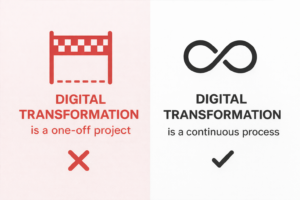
Digital Transformation is a one-time project with a finish line. A common misconception!
Here’s the reality ➡️ Digital Transformation is NOT linear, it’s continuous…
If a company treats digital transformation as a project, transformation stops once the implementation is done. No further updates, improvements, adjustment, transformation.
A fundamental mistake, that leads many digital transformation initiatives to failure.
When handled as a journey, digital transformation becomes about:
– constantly adapting to shifting customer expectations
– integrating new technologies as they emerge, and
– developing people and skills to stay ahead.
So, it’s not just about ticking off a digital checklist. True transformation is about building agility and resilience into the business. Don’t fall for the trap of understanding digital transformation as a quick, one-off project…
2. Future-proof
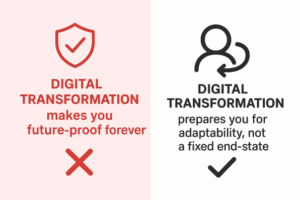
What if I told you that “Future Proof Once” doesn’t exist in Digital Transformation?
Believing you’re set forever is the fastest way to fall behind.
Think about retailers that digitized their checkout systems five years ago.
That was “future proof” then — but today the game is different:
- Contactless & mobile payments are standard.
- AI-driven personalization shapes customer choices.
- E-commerce integrations blur online and offline shopping.
The ones who stopped after their first upgrade are now struggling.
The ones who kept adapting are thriving.
Digital Transformation isn’t about reaching a finish line.
It’s about building the muscle for continuous change — so your business can pivot when the next wave hits.
3. Technology
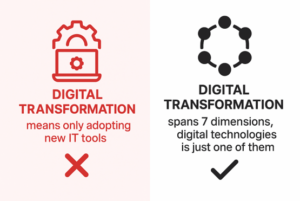
Digital Transformation is only about technologies
Unfortunately, it’s not that easy. I remember companies thinking that they were fully digitally transformed, because after COVID, they started using Zoom and MS Teams for meetings.
Some companies finally started using cloud technologies, moving some data to the cloud, so they could access it from home, in case, there was another lockdown.
While doing those things was certainly NOT WRONG, the truth about digital transformation is a bit more complex. IT tools (or digital tools) is only one part of one factor. We define 7 relevant and important dimensions of digital transformation:
🔴 Culture & Leadership
⚫️ Organization & Processes
🔴 Employees & Digital Skills
⚫️ Customers
🔴 Products & Innovation
⚫️ Digital Strategy
🔴 Digital Technologies (where we place IT/digital tools, and also “things” like AI)
Digital Transformation is NOT ONLY about implementing digital technologies or IT tools.
It’s about changing your mindset to a digital-first one, so your business can discover new digital business models and safe massive cost through efficiency gains.
4. Digital Marketing
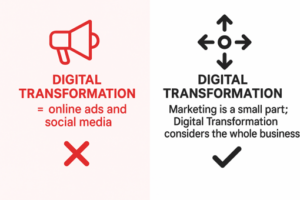
If you think digital transformation means running Facebook and/or Google ads, you’re missing out!
Many SMEs fall into the trap of equating digital transformation with better marketing campaigns.
While digital channels are important, transformation goes far deeper. It involves reimagining processes, upskilling employees, leveraging technology for efficiency, and aligning leadership with a digital-first mindset.
Only when the whole business is considered can transformation deliver sustainable impact.
👉 Don’t limit digital transformation to your marketing department. Look at the bigger picture: your strategy, people, processes, and technology. That’s where growth and resilience are built.
5. Paperless
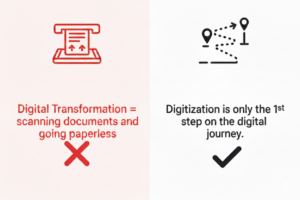
Going paperless equals Digital Transformation? That’s like calling a single brick an entire building.
Scanning documents and going paperless is a good step, but it’s only digitization, not Digital Transformation.
And here’s the difference:
Digitization = converting physical records into digital formats (scanning, archiving, paperless workflows, the foundation for digitalization).
Digital Transformation = rethinking how the whole business operates, competes, and creates value across all 7 dimensions: from leadership & culture to strategy, processes, skills, customers, innovation, and yes, technology.
When businesses confuse digitization for transformation, they stall progress. They get the illusion of being digital, while competitors move ahead by changing how they work, not just what format their data lives in.
6. Get Going
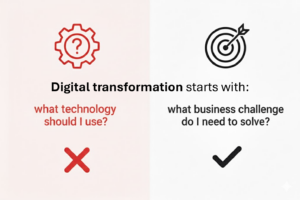
If your Digital Transformation starts with “What technology should I use?” — stop.
Start with a question that matters: “What business challenge do I need to solve?”
When you begin with tools, you risk:
- buying a solution that doesn’t fit your processes,
- piling tech on top of broken workflows,
- and frustrating people who must use it.
A problem-first approach does the opposite. It:
- clarifies the outcome you need (reduced lead times, higher NPS, lower costs),
- identifies the smallest change that delivers measurable value,
- and lets you validate with a pilot before scaling.
Quick real-world example: a small distributor spent on an expensive WMS because “everyone uses one.”
Result: complex rollout, low adoption.
Better path: map the top 2 operational pain points → redesign picking & packing process → add simple barcode scanning. Faster ROI. Happier staff.
Three practical steps to start today:
1. List your top 3 business challenges (not tech wishlists).
2. Pick one challenge and define a measurable outcome.
3. Run a small pilot that targets that outcome — then scale.
👉 Stop chasing shiny tech. Solve a real problem first, then choose the right tool.
7. Copycat
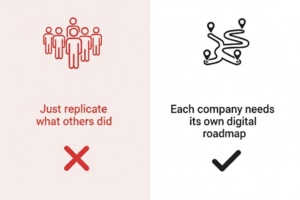
⚠️ Copying someone else’s digital roadmap is the fastest way to become a better second-place finisher.
Why copying fails:
- Competitors solve their constraints (supply chain, customer mix, margins) — not yours.
- You risk buying features you don’t need, creating complex processes that don’t fit, and wasting scarce change capacity.
- Culture, skills, legacy systems, and strategy differ — what worked for them can break you.
A better approach: design a roadmap around your unique value drivers.
Example: two retailers both “went omnichannel.” One matched inventory to demand and improved margins. The other copied the tech stack without fixing sourcing — and ended with overstock and lost margins.
Three practical steps to a differentiated roadmap:
1. Define what makes your business unique — customers, margins, channels, or service model.
2. Assess readiness across the 7 dimensions (leadership, people & skills, processes, customers, products, technology, strategy).
3. Prioritize small, measurable bets that align to your unique advantage — pilot, measure, then scale.
👉 Don’t chase someone else’s trophy. Build the roadmap that turns your strengths into competitive advantage.
More misconceptions about digital transformation (Part II: #08 – #14)
More misconceptions about digital transformation (Part III: #15 – #21)
