
21 popular misconceptions about digital transformation (Part III: #015 – #21)
SMEs are easily confused on what digital transformation means and how it can help them to stay competitive. Hype, misuse and shortcuts lead to common misconceptions. We have compiled a summary of the 21 most popular and are sharing those in 3 blog-posts. Here are the last seven:
15. Cloud
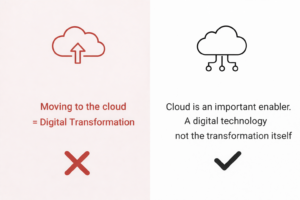
Cloud is not the destination. It’s the infrastructure.
Many organizations still believe that moving workloads to the cloud is digital transformation.
It’s not.
Cloud computing is a digital technology. A powerful one. But technology alone does not transform a business.
What cloud actually enables:
- Faster experimentation and scalability
- Better data availability and integration
- New digital services and business models
- More flexible ways of working
What cloud does not guarantee:
- Business impact
- New value creation
- Better customer experience
- Competitive advantage
Moving to the cloud without changing how you create value simply moves old problems to a new platform.
Digital transformation starts with:
- Clear business objectives
- Rethinking processes and operating models
- Empowering people with the right skills
- Using digital technologies in service of value creation
Cloud matters. But transformation happens when technology, strategy, people, and processes move together.
16. Provider
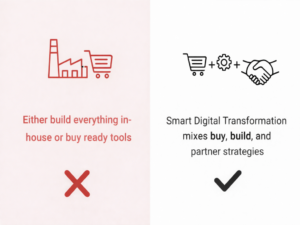
Technology decisions are often framed as a false dilemma. Many organizations believe they must either build everything in-house, or buy off-the-shelf tools and adapt the business around them.
This thinking slows down digital transformation and increases risk. Digital transformation is not a purity test. It’s a value creation exercise.
What this means in practice:
- Buy where speed, maturity, and standardization matter
- Build where differentiation creates competitive advantage
- Partner where capabilities are missing or time-to-market is critical
Common mistakes to avoid:
- Overengineering solutions that already exist
- Locking the business into rigid tools with no flexibility
- Treating vendors as suppliers instead of strategic partners
Strong technology choices start with:
- Clear business priorities
- A realistic view of internal capabilities
- An ecosystem mindset, not a tooling mindset
Digital transformation is not about owning everything. It’s about orchestrating the right capabilities to create value.
17. Cyber Security
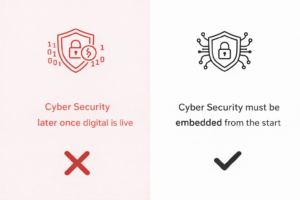
Cyber Security in Digital Transformation is not a feature you add later. It’s a foundation you design from day one.
In many digital transformation initiatives, cybersecurity is treated as a final checkpoint. Build the system first. Launch the platform. Then bring in security to “lock things down.” That approach worked in slower, less connected environments. It does not work in a digital business.
Modern organizations operate with:
- cloud platforms
- connected systems
- APIs and integrations
- data flowing across partners, customers, and devices
In this environment, security cannot be an afterthought.
When cybersecurity is integrated into digital transformation early, organizations benefit from:
- Stronger trust with customers and partners
• Fewer costly redesigns later in the project
• More resilient digital platforms
• Faster innovation because security becomes part of the architecture, not a blocker
Cybersecurity should therefore be part of:
- digital architecture decisions
- technology selection
- process design
- employee awareness and training
Digital transformation increases connectivity, speed, and data usage. Without cybersecurity embedded from the beginning, these same strengths can quickly become risks. The most successful organizations treat cybersecurity as a strategic capability, not a technical afterthought.
Because in the digital economy, trust is part of the product.
18. Focus
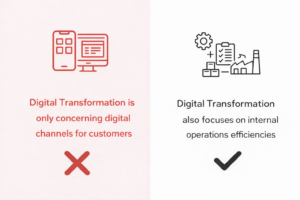
Digital Transformation is NOT just about customer-facing channels!
Many organizations start their digital transformation journey with:
– a new website
– a mobile app
– improved digital marketing
That’s visible. That’s tangible. But it’s only one part of the story.
If you only digitize the front-end, but keep inefficient processes behind the scenes, you create a gap:
– customers expect speed, but operations can’t keep up
– digital demand increases, but manual processes slow everything down
– costs rise while experience suffers
Real digital transformation connects front-end and back-end.
It means:
• Streamlining processes across departments
• Automating repetitive tasks
• Integrating systems and data flows
• Enabling employees with better tools
Because operational excellence is what makes great customer experience scalable. The companies that get this right don’t just look digital. They operate digitally.
And that’s where efficiency turns into real competitive advantage.
And that’s also why our framework for digital transformation consists of 7 dimensions with internal (operational efficiency) AND external (customer-centricity) focus…
19. Innovation
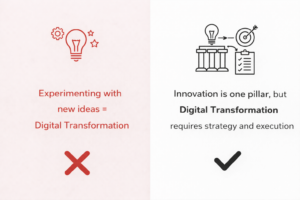
Digital transformation misconception #19: InnovationTrying new ideas is not the same as transforming your business. Many organizations proudly say:
“We’re experimenting. We’re innovating. We’re testing new tools.”
That’s great. But without direction, it often leads to noise instead of impact. You end up with:
- disconnected pilots
- isolated use cases
- innovation without scale
- energy… but no measurable business outcome
Innovation is essential. But on its own, it does not transform anything. Digital transformation happens when:
• Innovation aligns with clear business objectives
• Ideas are translated into structured initiatives
• There is ownership, governance, and accountability
• Execution is consistent across the organization
Without strategy, innovation is random. Without execution, innovation is wasted. The real challenge is not generating ideas. It’s connecting ideas to outcomes. The organizations that succeed don’t just experiment. They align, prioritize, and execute at scale.
Because in digital transformation, value is not created in ideation — it’s created in execution.
20. Data
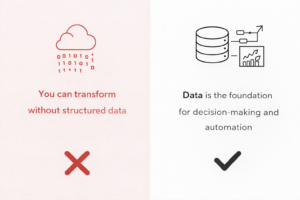
No data, no transformation. It’s that simple.
Many organizations push forward with digital initiatives—new tools, new systems, new platforms—
but overlook one critical element: structured, usable data. The assumption? “We’ll fix the data later.”
That’s where things start to break. Without structured data:
- automation doesn’t work reliably
- insights are inconsistent or misleading
- systems don’t integrate properly
- decisions are based on assumptions, not facts
You don’t get transformation. You get digital chaos. Real digital transformation depends on:
• Clean, structured, and accessible data
• Clear data ownership and governance
• Integration across systems and processes
• The ability to turn data into actionable insights
Because every key capability (AI, automation, analytics) relies on data as its foundation.
The uncomfortable truth:
Most organizations don’t have a technology problem. They have a data problem. Fix the data, and many transformation challenges become solvable. Ignore it, and even the best technology will fail to deliver value.
21. Risk
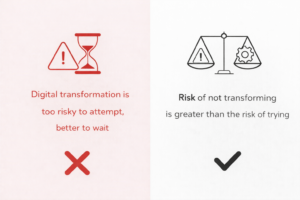
Waiting feels safe. In reality, it’s the riskiest move you can make.
Many organizations hesitate when it comes to digital transformation:
“What if it fails?”
“What if we invest and don’t see returns?”
“What if we disrupt what already works?”
So they delay. They observe. They wait. A huge risk. Because while you wait:
- competitors improve efficiency and reduce costs
- customer expectations continue to rise
- digital-native players enter your market
- your processes become increasingly outdated
The risk doesn’t disappear. It compounds quietly in the background. Digital transformation is not risk-free. But the goal is not to eliminate risk, it’s to manage it intelligently.
That means:
• Starting with clear priorities and business outcomes
• Taking iterative, controlled steps instead of big-bang changes
• Building capabilities over time
• Learning and adapting quickly
The real shift is this: From avoiding risk → to actively managing and leveraging it.
Because in today’s environment, standing still is not stability. It’s slow decline.
The question is no longer: “Can we afford to transform?” It’s: “Can we afford not to?”
More misconceptions about digital transformation (Part I: #01 – #07)
More misconceptions about digital transformation (Part II: #08 – #14)
Connect with us on LinkedIn
