
Why Digital Transformation Fails: The Hidden Risks of Ignoring Key Dimensions
A structured look at what happens when one of the seven dimensions of digital transformation is missing
Digital transformation has become a business necessity. Yet, despite heavy investments in technology, many organizations (especially SMEs) struggle to achieve meaningful results. The problem is rarely the technology itself. It is the lack of a structured, holistic approach to digital transformation. Too often, businesses focus on one or two areas (typically tools or systems) while overlooking the broader picture. This fragmented approach leads to misalignment, inefficiencies, and ultimately failure. Why Digital Transformation Fails: The Hidden Risks of Ignoring Key Dimensions
A successful digital transformation requires balancing seven critical dimensions:
- Culture & Digital Leadership
- Digital Technologies
- Organization & Processes
- Employees & Digital Skills
- Customers
- Products & Innovation
- Digital Strategy
These dimensions are not independent. They are deeply interconnected. That is what our entire digital transformation framework is about!
The key insight is simple:
Ignoring even one dimension creates a predictable failure pattern.
This article explores exactly that. Using a “missing dimension” perspective, we highlight what happens when each of the seven dimensions is neglected, and why so many digital transformation initiatives fall short.
Understanding the Risk: The Missing Dimension Perspective
Digital transformation is often approached as a checklist. Implement a system. Launch a platform. Automate a process. But transformation is not about isolated actions. It is about system-wide change. The “missing dimension” perspective flips the narrative.
Instead of asking what to do, it asks: What happens if we don’t?
Each missing dimension creates a specific and repeatable outcome. These are not random failures. They are systematic consequences of imbalance. For SMEs, this perspective is particularly valuable. Limited resources mean there is little room for trial and error. Recognizing these patterns early can prevent costly missteps.
Let’s walk through the seven dimensions, and the risks of ignoring each one.
What Happens When Each Dimension Is Missing
Let’s navigate now through all 7 dimensions of our digital transformation framework and figure out, what happens, when we ignore or overlook a specific dimension.
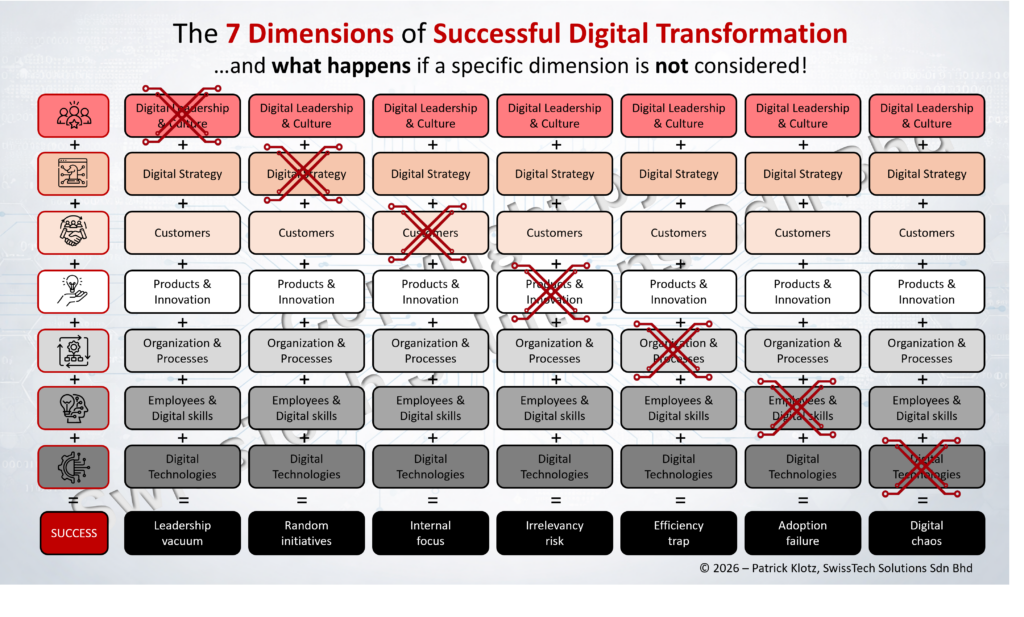
1. Missing Culture & Digital Leadership → Leadership vacuum
Without strong leadership, digital transformation lacks direction. There is no clear vision, no prioritization, and no accountability.
In many SMEs, digital initiatives are delegated to IT or middle management. As a result, transformation is perceived as a technical upgrade rather than a strategic shift. Employees follow instructions, but they do not embrace change.
Digital transformation requires leaders who actively drive change, communicate purpose, and align the organization. Without this, initiatives stall or fragment.
2. Missing Digital Technologies → Paper Digitization
One of the most common misconceptions is equating digitization with digital transformation.
When digital technologies are missing—or poorly implemented—organizations simply replicate manual processes in digital form. Spreadsheets replace paper. Emails replace workflows. But the underlying inefficiencies remain.
Legacy systems further limit scalability and integration. Without the right technology foundation, automation, data analytics, and innovation become nearly impossible.
The result is “digital” in name only—without real transformation impact.
3. Missing Organization & Processes → Digital Chaos
Technology alone does not fix broken processes. In fact, it often makes them worse.
When organizations digitize without rethinking their processes, inefficiencies are amplified. Bottlenecks become faster. Errors scale. Complexity increases.
This leads to what can be described as digital chaos—a landscape of disconnected tools, inconsistent workflows, and unclear responsibilities.
Digital transformation must include process redesign. Otherwise, businesses risk accelerating the very problems they aim to solve.
4. Missing Employees & Digital Skills → Adoption Failure
Even the best systems fail if people do not use them effectively.
A lack of digital skills creates hesitation, frustration, and resistance. Employees may revert to old ways of working or use new tools incorrectly. Productivity drops instead of improving.
In many cases, organizations underestimate the human side of transformation. Training is treated as an afterthought, rather than a core component.
Digital transformation is ultimately about people. Without the right skills and mindset, adoption fails—and with it, the entire initiative.
5. Missing Customers → Internal Focus
Some organizations approach digital transformation purely from an internal perspective. They focus on efficiency, cost reduction, and process optimization.
While these are important, they are not enough.
Ignoring the customer dimension creates a disconnect between internal improvements and external expectations. Customers continue to evolve—demanding faster, simpler, and more personalized experiences.
If transformation efforts do not address these needs, businesses risk becoming operationally efficient but commercially irrelevant.
Digital transformation must be customer-centric to create real value.
6. Missing Products & Innovation → Efficiency Trap
Improving efficiency is often the first goal of digital transformation. But stopping there is a strategic mistake.
When organizations neglect products and innovation, they fall into the efficiency trap. They become better at delivering existing offerings—but fail to create new value.
Markets evolve. Competitors innovate. Customer expectations shift.
Without a focus on innovation, businesses may improve margins in the short term, but lose relevance in the long run. True digital transformation enables not just better operations, but new business models, products, and revenue streams.
7. Missing Digital Strategy → Random Initiatives
Without a clear digital strategy, transformation becomes a collection of disconnected projects.
Different departments pursue their own initiatives. Investments are made without clear priorities. Success is difficult to measure.
This leads to random initiatives—activity without impact.
A strong digital strategy provides direction. It aligns digital efforts with business goals, defines priorities, and ensures that resources are used effectively.
Without it, even well-executed projects fail to deliver meaningful results.
Why These Failures Are Predictable (But Avoidable)
One of the most important takeaways is this: Digital transformation failures are rarely random. They follow patterns. Organizations that struggle with adoption often lack digital skills. Those that experience fragmented initiatives usually lack strategy. Businesses that see limited impact from technology often ignore processes. These patterns are consistent across industries and company sizes.
For SMEs, the challenge is even greater. Limited budgets and resources mean there is less margin for error. A single missing dimension can derail the entire transformation effort. However, the predictability of these failures is also an advantage. It means they can be anticipated—and avoided. By understanding the seven dimensions of digital transformation and ensuring that each one is addressed, organizations can significantly increase their chances of success.
A Holistic Approach to Digital Transformation
Digital transformation is not a project. It is not a system implementation. And it is not a one-time initiative. It is a holistic, organization-wide change. The seven dimensions provide a structured way to approach this complexity. They ensure that transformation efforts are balanced, aligned, and comprehensive.
- Culture & Digital Leadership drives direction and commitment
- Digital Technologies enable capabilities and scalability
- Organization & Processes ensure efficiency and consistency
- Employees & Digital Skills enable adoption and execution
- Customers define value and relevance
- Products & Innovation drive growth and differentiation
- Digital Strategy aligns everything toward clear goals
When these dimensions work together, digital transformation becomes sustainable and impactful.
This is where a structured approach—such as a phased roadmap from awareness to execution—becomes critical. It allows organizations to assess their current state, identify gaps, and build a clear path forward.
Digital Transformation Success Is a System, Not a Project
Digital transformation continues to be a top priority for businesses worldwide. Yet, many initiatives fail to deliver the expected results. The reason is not complexity. It is imbalance. Focusing on isolated elements—such as technology or efficiency—while ignoring others creates predictable failure patterns. Each missing dimension introduces a specific risk that undermines the entire effort.
The key message is clear:
A successful digital transformation requires all seven dimensions to be addressed.
It is not about doing more. It is about doing the right things. Together, in a structured way. For SMEs, this understanding is particularly powerful. It provides clarity in a complex landscape and helps avoid costly mistakes. If you are currently navigating your digital transformation journey, the question is simple: Which dimension might you be overlooking?
If you want to assess your organization’s readiness across all seven dimensions of digital transformation, or need support in building a structured roadmap, now is the time to take the next step. A clear, holistic approach can make the difference between isolated initiatives, and real, measurable success.
Read more about common misconceptions about digital transformation here.
And get an idea, why we believe every company should have a chief digital officer role…
Follow our LinkedIn page
